
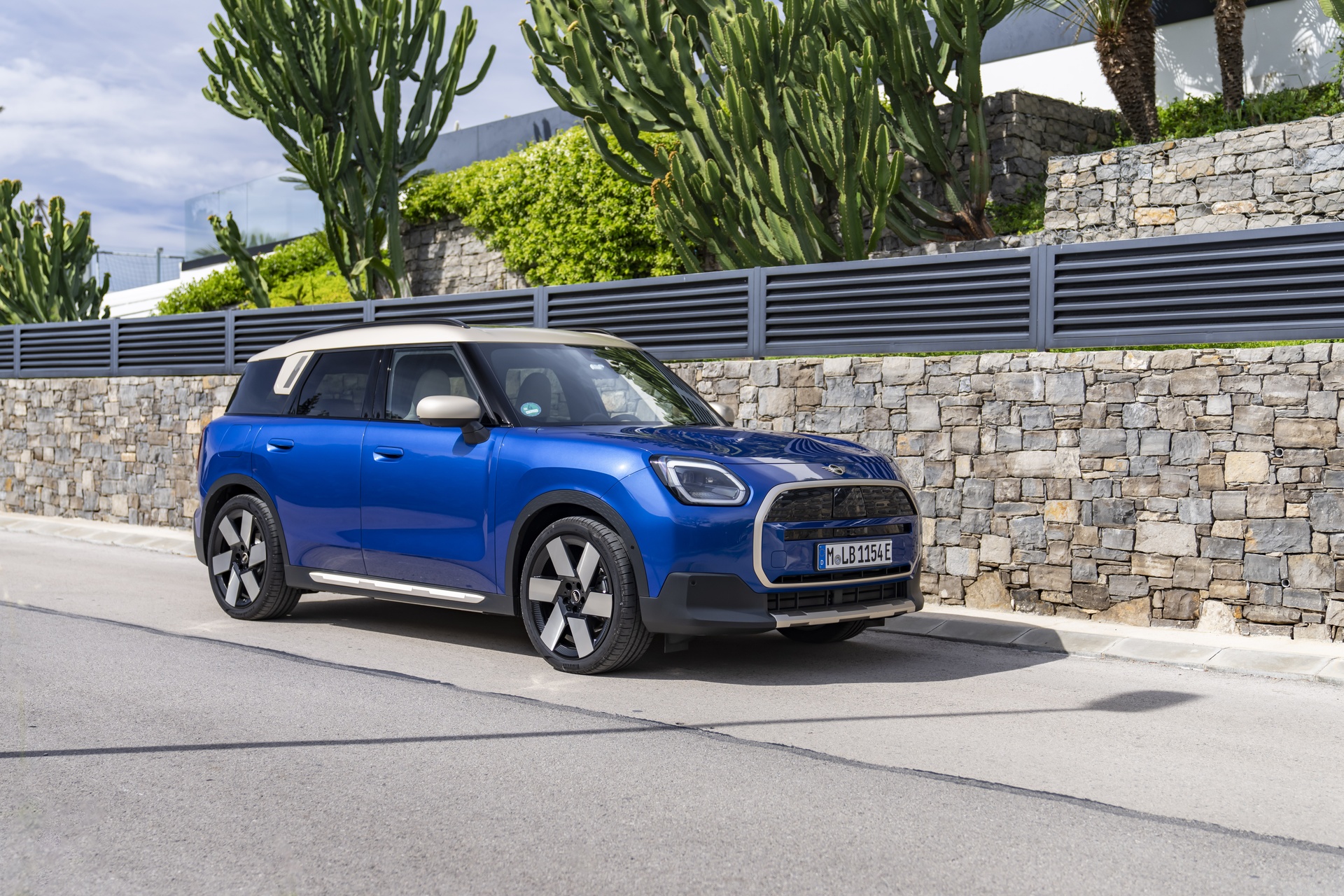
MINI has spent decades convincing people that small cars can be entertaining. The original formula was simple: take a tiny car, give it a personality larger than its physical dimensions, and make driving it feel like an amusement park ride that occasionally requires parallel parking. The modern MINI lineup has expanded considerably, however, and the 2026 MINI Countryman SE ALL4 is evidence that the brand’s definition of “small” has become flexible.
This is the largest MINI in the lineup, although calling it a MINI still feels appropriate in the same way that calling a Great Dane a lapdog is technically possible but requires some explanation.
The Countryman SE takes the familiar Countryman crossover formula and replaces its gasoline powertrain with an all-electric setup. It also adds standard all-wheel drive, plenty of technology, and enough horsepower to make the little SUV feel considerably more energetic than its somewhat upright appearance suggests.
It’s an interesting combination. Unfortunately, it also comes with a few compromises that make the Countryman a more appealing urban companion than an electric road-trip champion.
Exterior: MINI Personality, Supersized
The Countryman has grown considerably since its introduction. The 2026 model measures approximately 175 inches long, making it a legitimate small crossover rather than the slightly oversized hatchback the original Countryman resembled.
MINI has managed to retain its recognizable styling despite the additional bulk. The upright windshield, contrasting roof options, distinctive lighting, and squared-off proportions give it an identity that doesn’t get confused with the seemingly endless parade of anonymous crossovers currently occupying dealership lots.
The front end is particularly interesting. The traditional grille treatment has evolved into a largely closed-off design appropriate for an electric vehicle. There are still plenty of visual cues suggesting this is a MINI, even if the absence of a traditional engine means there’s no need to feed quite so much air into its nose.
The rear styling is similarly distinctive, with vertically oriented taillights and a fairly upright hatch. It’s a handsome little crossover, although the term “little” is becoming increasingly generous.
The Countryman SE also gets some visual differentiation from its gasoline-powered siblings. It’s not dramatically different, but the EV-specific details provide enough distinction to remind people that this one plugs in rather than drinks petroleum.
That’s probably a good thing. Otherwise, someone might accidentally put premium gasoline in the charging port. Stranger things have happened.




Interior: Welcome to the Circularity of Eco
MINI has always been willing to experiment with interior design. Sometimes that experimentation produces something genuinely charming. Other times, it produces something that makes you wonder whether the designers were competing to see how many things could be controlled through a single screen.
The Countryman SE leans heavily toward the former, although there’s a little of the latter mixed in.
The centerpiece is a large, circular 9.4-inch OLED touchscreen positioned prominently in the dashboard. It’s an unusual design choice in a world where nearly every automaker seems determined to install increasingly enormous rectangular tablets.
The circular display is visually interesting and reinforces MINI’s design identity. It also handles a considerable amount of the vehicle’s infotainment and control functions.
Unfortunately, not everything needs to be operated through a touchscreen. Basic vehicle functions are generally easier to use when there’s a physical button or knob involved. MINI has retained some physical controls, thankfully, but the interface still requires a learning period.
The interior materials and overall presentation feel appropriately premium for a vehicle starting around $45,000. There are interesting textures, distinctive trim treatments, and plenty of opportunities for personalization.
Front-seat accommodations are comfortable, and the rear seat offers reasonable room for passengers. The Countryman is more practical than its smaller Cooper relatives, although cargo space remains somewhat limited compared with some competing electric crossovers.
There’s approximately 24.8 cubic feet of cargo capacity behind the rear seats, expanding to around 56 cubic feet when those seats are folded.
That’s enough for groceries, luggage, or a weekend’s worth of questionable purchasing decisions at the home improvement store.
Performance: Electric Motors Make Everything More Interesting
The Countryman SE ALL4 uses a dual-motor electric powertrain producing 308 horsepower and 364 lb-ft of torque.
That’s a respectable amount of output for a compact crossover, particularly one that weighs considerably more than the classic MINI Cooper that made the brand famous.
Power goes to all four wheels through MINI’s ALL4 all-wheel-drive system. Acceleration is brisk, with MINI quoting a 0-to-60-mph time of approximately 5.4 seconds.
The instant torque delivery makes the Countryman feel energetic from a standstill. There’s no waiting for a turbocharger to spool up, no transmission searching for the appropriate gear, and no dramatic engine noise accompanying acceleration.
Just electricity and forward motion.
The result is a crossover that’s considerably quicker than its styling might suggest. It isn’t a performance SUV in the traditional sense, but there’s enough enthusiasm in the powertrain to make merging, passing, and navigating urban traffic entertaining.
Handling is another area where MINI’s personality comes through. The Countryman feels composed and responsive, with steering that’s reasonably direct and a chassis that encourages enthusiastic driving.
Of course, there’s a difference between enthusiastic driving and pretending you’re competing in the Monte Carlo Rally on your way to the grocery store.
The Countryman can be entertaining without requiring that level of commitment.
The ride, however, can become somewhat firm over rough pavement. That’s not unusual for a vehicle wearing the MINI badge, but buyers expecting a particularly cushy luxury crossover may find the suspension less accommodating than anticipated.
The Countryman SE is happiest on reasonably smooth pavement, where its combination of power and responsive handling makes it enjoyable to drive.
Range and Charging: The Not-So-MINI Limitation
The biggest compromise with the Countryman SE is its driving range.
The vehicle uses a battery pack with approximately 64.7 kWh of usable capacity and carries an EPA-estimated driving range of up to 212 miles on the standard 18-inch wheels. Models equipped with larger 19-inch wheels see that figure decrease to approximately 204 miles.
Those numbers aren’t disastrous, but they’re hardly impressive in a market where several competitors offer considerably more range.
For comparison, the Countryman’s performance-oriented dual-motor configuration delivers plenty of horsepower, but buyers pay for that enthusiasm with a relatively modest battery range.
It’s a familiar EV compromise. More power, more weight, and all-wheel drive can make for an entertaining vehicle, but they don’t necessarily help efficiency.
DC fast charging is rated at up to 130 kW, with MINI estimating a 10-to-80-percent charging session at approximately 30 minutes under suitable conditions.
Home charging is considerably more convenient. Using a Level 2 charger, owners can replenish the battery overnight and start each morning with a full charge.
That’s where the Countryman makes the most sense. As a commuter, suburban runabout, and general-purpose urban crossover, 212 miles of range should be adequate for many owners.
Long-distance travelers will need to plan charging stops more carefully. The Countryman isn’t necessarily the vehicle I’d choose for an ambitious interstate road trip unless I particularly enjoyed spending time at charging stations.
There’s nothing wrong with taking a break during a road trip. There’s something less appealing about having that break dictated by a battery percentage.
Technology and Safety
MINI has equipped the Countryman SE with a substantial collection of technology.
The circular OLED display provides access to infotainment, navigation, vehicle settings, and other functions. Smartphone integration and connected services help make the system feel reasonably modern.
There are also various driver-assistance technologies available, including adaptive cruise control and lane-related assistance features, depending on configuration.
The vehicle’s technology package is one of its stronger selling points, although the touchscreen-heavy interface can occasionally make simple tasks more complicated than necessary.
MINI also offers different driving experiences through its Experience Modes. These alter various aspects of the vehicle’s presentation and behavior, providing opportunities to customize the driving experience.
It’s a little theatrical, but that’s part of the MINI appeal. The brand has never been particularly interested in making vehicles that feel like appliances.
Pricing for Not-So-Mini Budgets
The 2026 MINI Countryman SE ALL4 starts at approximately $45,200, with higher trims and optional equipment pushing the price closer to $50,000.
That’s a substantial amount of money for a vehicle with just over 200 miles of EPA-estimated range.
The MINI counters superior competition with distinctive styling, standard all-wheel drive, strong acceleration, and an interior that doesn’t look like it was designed by someone whose entire furniture collection came from a technology showroom.
Whether those qualities justify the price depends largely on what buyers value. The Countryman isn’t attempting to be the most practical or affordable EV in its segment. It’s trying to be a MINI that happens to run on electricity. That’s a slightly different proposition.
Verdict: A MINI With Maxi Personality
The 2026 MINI Countryman SE ALL4 is an entertaining electric crossover with plenty of personality. Its 308 horsepower, standard all-wheel drive, distinctive styling, and unusual interior design make it stand out in a segment increasingly dominated by vehicles that look like variations of the same aerodynamic potato.
It’s also reasonably practical, comfortable enough for everyday use, and quick enough to make ordinary driving more entertaining.
The biggest drawback is range. Just over 200 miles isn’t particularly competitive at this price point, especially when several alternatives offer more flexibility for longer trips.
The touchscreen interface also takes some getting used to, and the ride can be firmer than some buyers might prefer.
Still, there’s something appealing about the Countryman. It doesn’t take itself too seriously, and it manages to inject some personality into a vehicle category that desperately needs it.
Would I choose it as my primary long-distance travel vehicle? Probably not.
Would I enjoy driving one around town, taking the occasional backroad detour, and parking it somewhere people could admire its slightly ridiculous proportions? Absolutely.
The Countryman SE is proof that electrification doesn’t have to mean surrendering personality. It just means that instead of stopping for gasoline, you’ll occasionally need to stop for electrons.


