
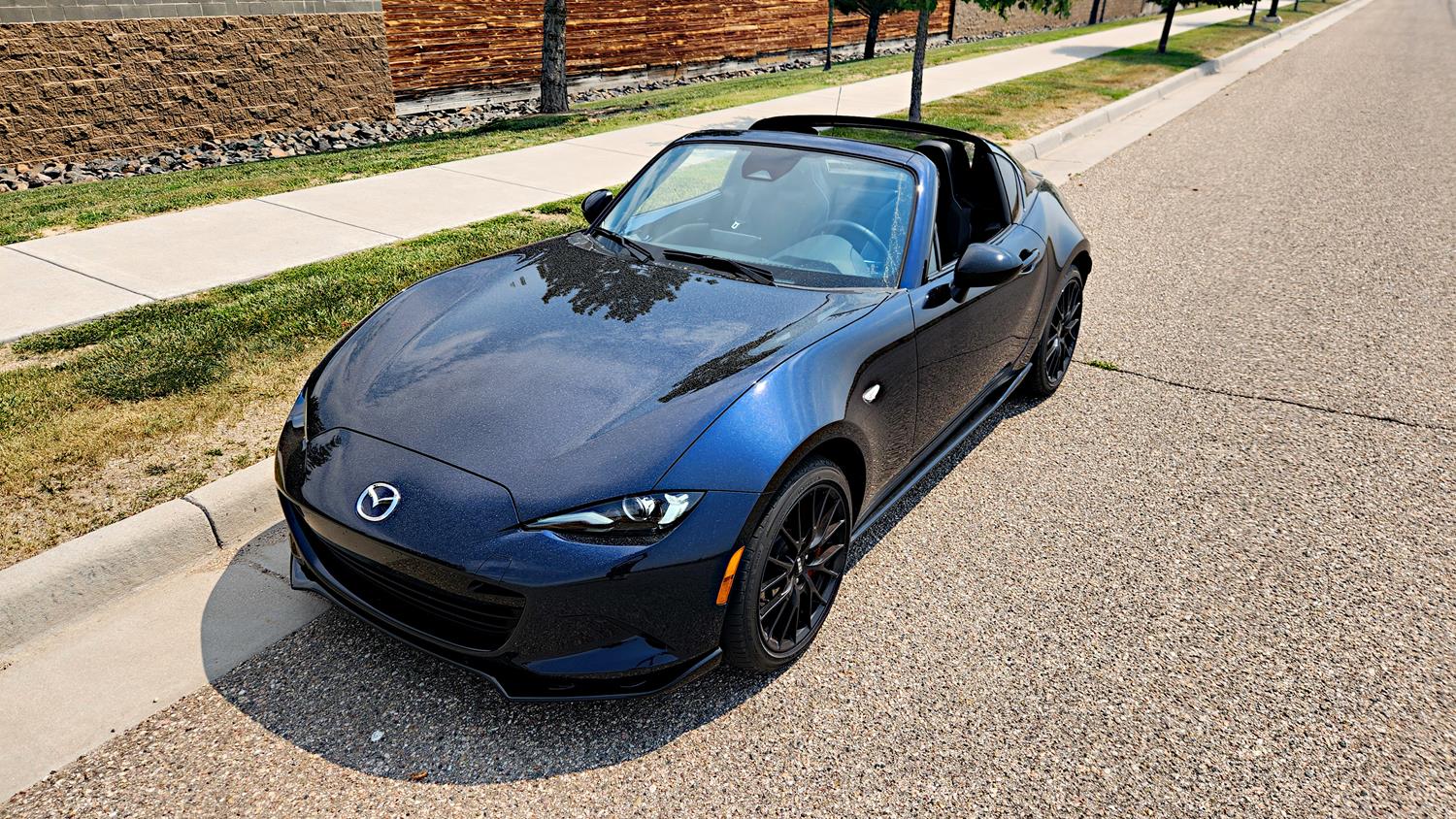
There are cars that make you feel important. There are cars that make you feel successful. There are cars that make your neighbors wonder whether you have recently won the lottery.
And then there is the Mazda MX-5 Miata, which mostly makes you grin like an idiot.
The 2026 MX-5 remains stubbornly committed to the idea that a sports car doesn’t need to have the horsepower of a small aircraft carrier, weigh approximately as much as one, or cost the gross domestic product of a minor nation. It just needs to be fun.
The MX-5 is built around an idea that seems almost quaint in 2026: lightness matters.
Mazda has been preaching this gospel since the first Miata arrived in 1989, and the basic recipe remains gloriously uncomplicated. Put a reasonably powerful engine in a small car. Drive the rear wheels. Give it a manual transmission. Keep the weight down. Add steering that actually communicates with the driver. Then let physics do the rest.
The 2026 Miata doesn’t need to punch you in the kidneys every time you touch the accelerator. It doesn’t need launch control. It doesn’t need horsepower measured in hundreds and a theoretical physics degree just to get around a corner.
It just goes.
And then it goes around corners.
And then you find another corner.
This is how the Miata gets you.
It’s Not Fast. It’s Quick.
The 2.0-liter four-cylinder produces 181 horsepower and 151 lb-ft of torque. Those numbers would have been respectable in a family sedan a couple of decades ago, and today they look downright adorable next to the output figures of modern performance cars.
But the Miata weighs roughly 2,300 pounds, depending on configuration. That changes everything.
The car doesn’t have to overcome several thousand pounds of luxury equipment, sound insulation, batteries, enormous wheels, electronic gadgetry, and whatever else we’ve decided must be attached to automobiles these days. You merely press the throttle and the Miata responds.
There is no lengthy negotiation with the engine. No committee meeting. No “please hold while the transmission determines your request.” Just go.
The MX-5’s six-speed manual remains one of the great pleasures of automotive life. The throws are short, the clutch is friendly, and the pedals seem to have been positioned specifically for people who enjoy making unnecessary downshifts simply because they can.
Which, incidentally, is the correct way to drive a Miata. Don’t buy the automatic.





Steering That Talks Back
The Miata’s greatest trick isn’t acceleration. It’s communication.
Modern cars have become remarkably good at isolating occupants from the road. This is wonderful when you’re driving 700 miles across Nebraska in a blizzard. It’s somewhat less wonderful when you’re trying to have fun on a winding road.
The MX-5 doesn’t isolate you quite so aggressively. The steering is light but precise, and the chassis feels eager without becoming nervous. You can place the car exactly where you want it, and because there’s relatively little mass involved, the consequences of changing direction are immediate.
The Miata doesn’t merely turn, it seems pleased that you asked.
Throw it into a corner and the car rotates with an enthusiasm that makes you wonder whether Mazda engineers secretly spend their weekends stealing shopping carts and racing them through parking lots. The whole experience is playful rather than intimidating. And that’s important. It’s the Miata’s whole driving philosophy in one movement.
You can drive a Miata quickly without constantly feeling as though you’re one poorly judged throttle input away from appearing in the local news.
The Convertible Is the Point
The drop-top MX-5 is still the purest expression of the idea. Drop the roof. Find a winding road. Turn off the radio. Suddenly, 50 mph feels like an event.
This is one of the Miata’s most enduring qualities. It makes modest speeds entertaining. You don’t need to be traveling at felony velocity to enjoy yourself. There is wind. There is engine noise. There is tire noise. There are birds, insects, trucks, motorcycles, and occasionally the confused expression of someone in a crossover wondering why you’re smiling so much.
It’s gloriously analog.
The RF version adds a retractable hardtop and a slightly more coupe-like personality. It looks fantastic and offers some additional weather protection, although it also gives up some of the open-air simplicity that makes the soft-top so charming.
Either way, the Miata remains a car where the roof is less a structural component and more of a suggestion.
Interior: Cozy Is Being Generous
The Miata’s cabin isn’t large. It is, in fact, approximately the size of a particularly ambitious shoebox. Someone of my size (6’3″, 250+ pounds) has to work a little to get into this car. Right foot in, point the butt at the seat, suck it in, drop. Easier than it looks, actually.
If you’re accustomed to modern SUVs, climbing into the MX-5 can produce the same sensation as entering a carry-on suitcase. Once inside, however, everything is remarkably easy to understand.
The controls are where you expect them to be. The driving position is excellent. The seats hold you securely without making you feel as though you’ve been strapped into a NASA launch capsule.
There is technology, naturally, because it is 2026 and apparently even a toaster needs Bluetooth now. But Mazda hasn’t allowed the technology to become the star of the show. The driver is still the main character.
Practicality Has Left the Building
There are two seats. The trunk is laughably small. There is no back seat. There is no secret cargo compartment where you can suddenly discover enough room for a Costco expedition.
You will learn to pack carefully. You will also learn that “packing carefully” means deciding whether you need both pairs of shoes.
The Miata is not practical in the traditional sense. But that’s missing the point. Nobody buys a Miata because they need to transport a washing machine. They buy it because they want to go somewhere. And preferably take the long way.
The MX-5’s biggest achievement is that it reminds us what automobiles used to be about.
Not transportation. Not lifestyle branding. Not optimizing your commute. Fun. Real, uncomplicated, mechanical fun.
The 2026 Mazda MX-5 Miata doesn’t have the biggest engine, the largest screen, the most seats, the longest list of electronic assistants, or enough horsepower to make a NASA nervous.
It doesn’t need any of that.
It has a small engine, two seats, rear-wheel drive, a wonderfully cooperative manual transmission, and a chassis that seems to regard every bend in the road as a personal invitation.
The result is a car that turns an ordinary drive into an occasion. And that’s becoming surprisingly rare. The Miata isn’t trying to impress you. It’s trying to make you laugh.
It succeeds.


